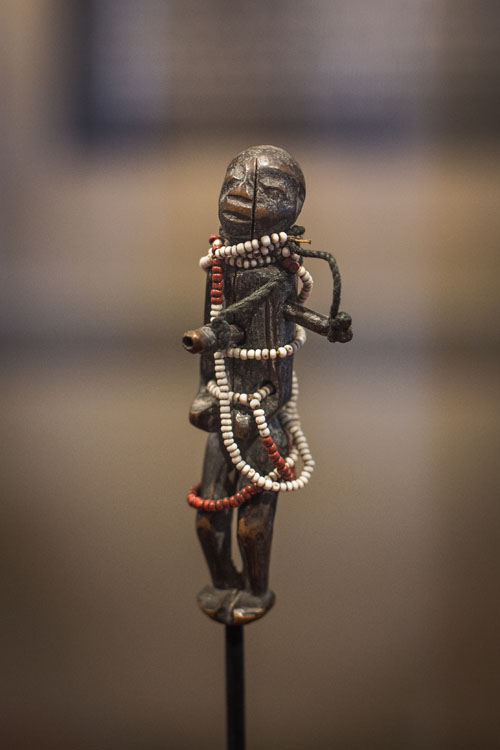
The spelling «vodou» is a phonetic adaptation of the Fongbé term: Vodoun. It is difficult for the European ear to pick up on all the phonetic subtleties of the Fongbé and Yoruba languages. In this case, the «n» ending in «vodoun» is virtually inaudible to Europeans unfamiliar with the subtle sounds of the Gbé languages (Ewe, Adja, Fon, Gen, Phla-Phera, spoken in Benin, Ghana, Togo and Nigeria) and Yoruba (a language of the Kwa group: Yoruba-Nago, spoken mainly in Benin and Nigeria).
In Benin, the term «voodoo» is not used. It is in fact the Fongbe word «vodoun» that is used to refer to the gods and their specific religious practices.
Vodou in Haiti, Voodoo in English… The spelling of the term for Vodou thus varies depending on how the colonists phonetically rendered it. It should be noted that the term «orisha», which refers to the gods in the Yoruba language—introduced by enslaved peoples from the Gulf of Guinea—is still used today in Brazil, whereas the word «vodoun» is not.
Various researchers who have studied the Voodoo religion from Ghana to Nigeria, via Togo and Benin, have noted the importance of phonetic nuances that give words very different meanings, even though they do not share a common spelling in French.
Bernard Maupoil spells it Vodũ (editor’s note: with a tilde over the u). The photographer and ethnologist Pierre Fatumbi Verger uses the term «vodoun». The ethnologist Albert de Surgy writes «vodu», whilst the anthropologist Klaus Hamberger and the historian Dominique Juhé-Beaulaton use the spelling «vodou», which is the one we have adopted.
What does the term «Vodoun» mean? Kéfil Houssou (a Beninese guide at the Château Vodou Museum) translates it as follows:
Make yourself comfortable, don't surround yourself with prejudice.
To draw, extract, to fetch.
In practice, this would mean: «To draw, in harmony, from the invisible realm what people need to flourish in the visible world».
The «vodou» being ancestral deities deeply linked to the vital forces of nature, from which they draw their powers and might, difficult to understand, feared, but so useful to mankind.
In short, the complexity and diversity of Voodoo rites and cults in Africa, whilst rooted in different cosmogonies, all share the same objective: To help humans and give meaning to their lives, to prepare them for their passage to the realm of the dead, by integrating this existence into a cosmos populated by ancestors and gods whose powers can be as helpful as they are feared.
«These rituals are generally directed towards the forces of nature and deified ancestors, and form a vast system that unites the dead and the living into a single, continuous and cohesive family unit.»
P. FATUMBI VERGER. Gods of Africa, Introduction. Editions Revue Noire, Paris 1995. 416 pp.
Jean-Yves ANEZO. Museum guide.
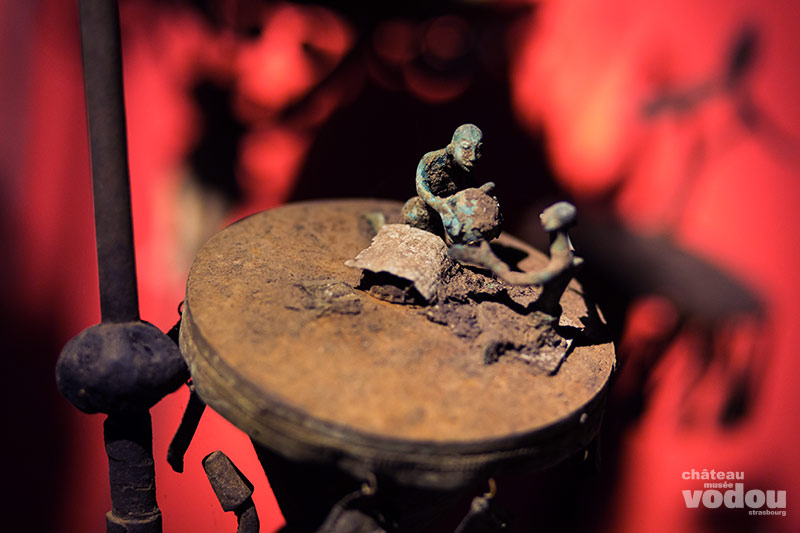
Voodoo, which emerged from the fusion of the Yoruba, Fon and Ewe religious traditions, took on the form we recognise today around the 17th century, during the establishment and subsequent expansion of the Fon Kingdom of Abomey.
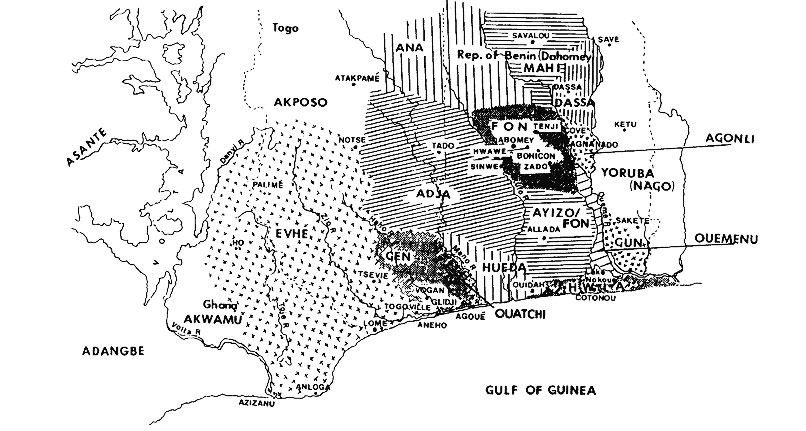
It will then become the cultural foundation of the peoples, stemming from successive migrations, of the Adja-Tado cultural area. Limited to the east by the Ouémé River, to the west by the Volta, and to the south by what was called the Slave Coast, the Adja-Tado cultural area extends to a depth of 200 to 300 km between degrees 0 and 3 longitude, in the heart of what geographers call the Sudanese savanna.
The population of this cultural area, as defined above, consists mainly of the following ethnic groups:
• The ADJA (AJA) in the area between the Yoto in Togo and the Couffo in Benin.
• The Ewe (Ewé) in the region between the Volta and the Yoto.
• The FON (FON) in the region between Ouémé and Couffo.
• The GUIN (GÊ) along the so-called Slave Coast.
• The XWLA and XWÉDA are located in the same geographical area as the Gê.
• The GOUN (GUN) primarily in the city of Porto-Novo and its surroundings.
The Aïzo (Ayizo) people around Lake Nokwé, the Allada region and its surroundings.
• The SAHWÉ people on the black soils of Ko, in the Bopa region.
It was during the reign of King Agadja (1708-1740) that Danhomè expanded southwards towards the Atlantic coast, after the capture of Allada in 1724 and then Ouidah in 1727. Its zone of influence would extend from the borders of the Oyo Empire (Nigeria) to the limits of the Ashanti Kingdom (present-day Ghana).,
This part of Africa was familiar with the cultures of Europe and North Africa, which explains why Voodoo incorporated Christian, Muslim and Jewish elements from its very inception.
From the outset, much like the societies in which it is found, Voodoo is a comprehensive and deeply intertwined religion.
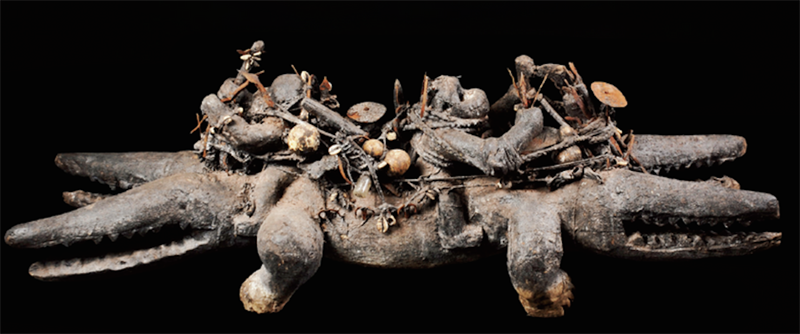
When we hear about voodoo, we tend to think of Hollywood-style voodoo scenes featuring violent trances, zombies and dolls pierced with needles, rather than a way of life practised by millions of people around the world.
It is true that Vodou is everywhere, not only in West Africa, its birthplace, but also in North America, South America, and the Caribbean since African slaves transported it there, as well as in Europe thanks to 20th-century migratory movements. Whether considered a religion or a philosophy of life, Vodou encompasses a vast field of beliefs and practices.
Voodoo is a way of understanding the world of this life and the afterlife as a single whole, in which humans depend on this other, invisible world, populated by ancestors, spirits, gods and all manner of energies capable of intervening in people’s lives. It could be said that every Voodoo story begins with a trauma: explanations for disasters, illnesses and deaths, wars and other calamities find their answers in this parallel world. Indeed, Voodoo is a way of interpreting such misfortune. Misfortune, ranging from a simple failure in an exam to a violent death, can then be interpreted as a message from elsewhere. Thus, with the help of Fa divination, people are led to communicate with this vast family of voodoo deities (there are currently said to be nearly 300 of them), all of whom are ambivalent, angry, jealous, vain and conceited. In a way, these vodous hold up a mirror to us.
Communication with this invisible world takes place through rituals, music and dance, but also through objects. Thus, wooden sculptures, bundles, masks, sticks, horns or bottles filled with herbs, transformed kitchen utensils, piles of indefinable materials, and a motley assortment of items sewn, threaded or tied together – such as those found in Marc Arbogast’s collection – tell us many personal and collective stories of people’s lives, both past and present. Nearly a thousand objects have been collected over the last thirty years in Nigeria, Benin, Togo and Ghana, and – by a strange twist of fate – have ended up at Château Vodou in Strasbourg.
Unlike most collections of African artefacts (whether public or private) that belong to the past, this is a collection of living art. For whilst at the Vodou Museum these objects may be found in display cases, elsewhere these same objects are venerated, placed on altars, on the outskirts of villages, on graves, inside bedrooms, hidden away from prying eyes. This is the distinctive feature and the very ambiguity of this collection, which is not found in most museums. Its contemporary nature therefore demands a different approach to understanding African art and requires reflection on how to exhibit these objects, which are part of the sacred realm of the present day. We must therefore reinvent a museum that speaks to the present and appeals just as much to voodoo practitioners as to casual museum-goers or artists. This is a vast undertaking for the museum of the 21st century, one that remains to be explored.
This Vodou museum is therefore an opportunity to discuss a still little-known philosophy and the incredible inventiveness that characterises Vodou. Because one only has to look at the objects in Marc Arbogast's collection to understand that this art has incredible elasticity, creating new forms each time – like new Vodous – by integrating Christian, Buddhist, Muslim, or Hindu elements, incorporating and transforming the most heterogeneous and incongruous materials. This jumble of incredible objects, fragments of misfortunes endured, expressions of suffering and resourcefulness, imbued with personal stories, frozen in time by their display in showcases, continues to surprise us and to question our human condition.
Nanette Jacomijn Snoep
To the few rare fundamental questions that arise for all men, whatever their origin (Who are we? Where are we? Where do we come from?), the populations of the Gulf of Benin (formerly Dahomey), particularly the Fon people, have provided an answer: Vodoun.
Far from clichés and Hollywood imagery, Vodun is the expression of an entire conception of life, a worldview, a practical and effective philosophy for humanity.
The origin of Vodun
The Kingdom of Dahomey, where Vodun flourished, was born in the 17th century following numerous migrations during which the Adja-Fon populations settled on the Abomey plateau.
Culturally and ethnically influenced by the Yorubas of Ife and Oyo in Nigeria and the Ashantis of Ghana, this small people would, over the years, found a powerful kingdom, a feared nation. Indeed, the slave trade in the 17th and 18th centuries intensified unprecedentedly and at such a pace that the balance of the populations affected was altered, and thereby the geopolitical balance between societies.
The adaptation of Danhomè to this terrible reality was first political, but it is not for us here to develop this complementary aspect of the evolution of Vodun, understood for the moment as a religion. It will suffice for us to say that after the founding of the kingdom by Houégbadja in 1625, when many gods already existed, Vodun became a true cultic system.
Under King Agadja (1708-1740), the Kingdom of Dahomey expanded and strengthened through its conquests. Wars allowed the king to capture enemies, who were resold as slaves to Europeans on the coasts. The slave trade thus enabled the kingdom to increase its material resources.
However, certain individuals among the captive populations (Mahis and Yorubas in particular), those possessing specific know-how, were not sold. They were assessed individually according to their abilities: for example, when some had occult talents and the forces they mastered did not exist in Dahomey, they were ennobled and installed as dignitaries, thus placing their knowledge at the disposal of the kingdom. Thus, the vodoun Sakpata (deity of the earth and smallpox) originates from Dassa, where the Nagos from Nigeria were present. The god of thunder, Hèbioso, comes from Houéda, whose inhabitants originated from a region in what is now Ghana. This explains the great variety of cults, crafts, and music found in the Dahomey region today.
During the second half of the 18th century, King Tegbessou structured the pantheon according to major families of vodoun, with individuals designated by the king to maintain them as part of an established protocol.
These large families are:
• Toxwio Agasu (the panther); ;
• Mawu-Lisa (founding couple); ;
• Hèbioso (lightning); ;
• Sakpata (earth and smallpox); ;
• Tovodoun-Nensuxwe (ancestors of the royal family); ;
• Yalode (the equivalent of Nensuxwe among the Yorubas).
The families are comprised of a very large number of deities, each having its own particular name. For example, in the family of Hèbioso, there is Sogbo (the father), Hou or Xwu (the mother), Avlekete or Toxosu (one of Hèbioso's abnormal children)...
Thus, under the successive conquests of successive sovereigns – particularly those of kings Agadja (1708-1740) and Tegbessou (1740-1774) – and the installation of new divinities taken from enemies who accompanied them, a rigorous and structured organisation of the Vodoun pantheon was established.
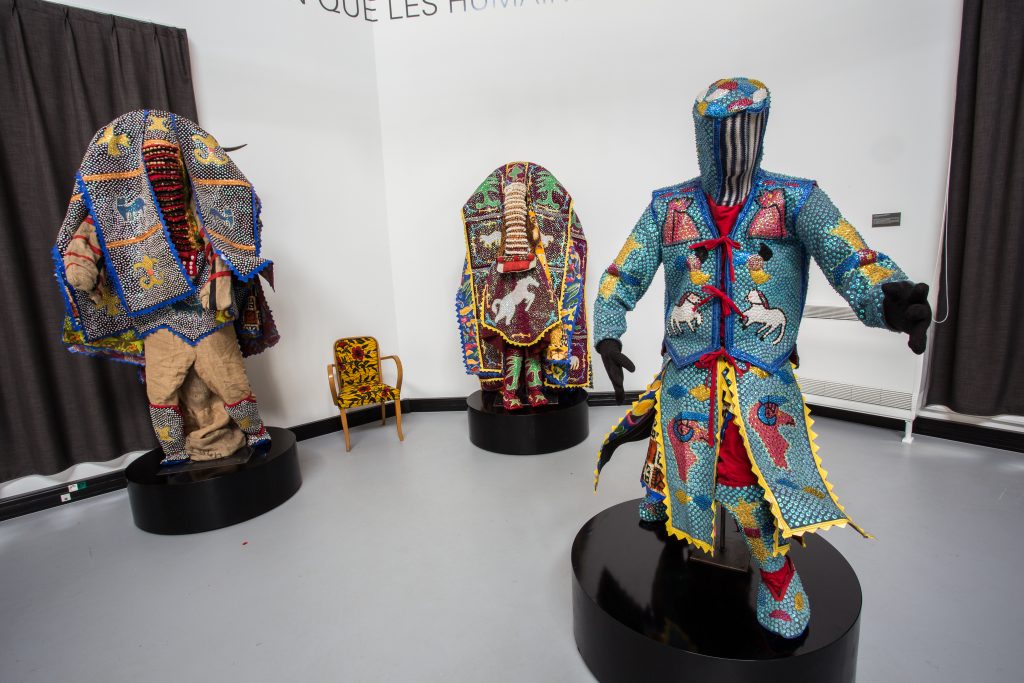
Next come the masked divinities: these are the Egungun (phantoms) and Oro (spirits of the dead), which go hand in hand, Zangbeto and the Bligede (guardians of the night), the Caleta (a Vodun with Brazilian inspiration).
The peculiarity of these masked deities is that they are mainly reserved for men, whereas women are widely represented in other cults.
Finally, some transversal vodouns are found within each of the major families: Legba (mediator of the pantheon, protective and virile deity), Toxosu (children born dead or abnormal), Dan (the rainbow serpent), Gu (the god of iron).
The deities in the pantheon essentially reflect natural forces, deified ancestors, and spiritual powers.
They help to maintain harmony between people, their social and cultural group, and nature, from which they draw what they need to live their lives to the fullest.
In Abomey, the pantheon is under the hierarchical authority of Zomandonou, the abnormal son of Akaba, belonging to the Tovodoun-Nensuxwe vodoun family, ancestors of the royal family. Thus, the pantheon is directly linked to the king's court, and the high priest of Zomandonou is the head of the supreme vodoun court, a college of wise religious elders.
One cannot speak of Vodoun in Dahomey without mentioning Fa. This divinatory art from ancient Egypt travelled via the Nile before arriving in Ife, Nigeria, and was then adopted and adapted by the Fon people.
This is a geomancy that deciphers the forces at play following throws of cowrie shells or wild apple bark, and provides an interpretation in order to draw recommendations.
The Fa divination has become the key to Vodoun, in the sense that it creates a language that allows humans to communicate with the gods. It should be emphasized that, without Fa, Vodoun would never have had a truly normative existence. Indeed, the analytical power of events produced by Fa has met the logic of Vodoun and given it an effectiveness and visibility that endure to this day.
Before becoming a recognised means of investigation and decision-making, Fa was practised unofficially in Danhomè. A historical anecdote explains how this divinatory practice was adopted by the royal court of Abomey. After King Akaba (1685-1708) was killed on the battlefield, the throne was entrusted to his twin sister, Hangbé (1708-1711). Determined to avenge her brother, she launched a victorious punitive expedition. Despite this, after three years she was forced to relinquish power to her younger brother, Agadja (1708-1740), even though their nephew, according to the rules, should have been her successor. Cursed, Agadja could not contain the invasion of Oyo (Nigeria), the tribute from which would soon ruin his kingdom. Furthermore, a terrible drought, followed by famine, struck the country. Distraught, King Agadja sought a solution and entrusted his fate to a Fa priest of Yoruba origin. The oracle then revealed to him that, to lift the curse he was suffering from, he must first apologise to an offended lady, whom the king immediately recognised as his sister Hangbé. He complied. The Fa priest then began the required rituals, which concluded with a propitious rain. Once his mission was accomplished, he returned home, but Agadja had him return twice more, hoping he would continue to make it rain (hence the name «rain seller», «Djissa», which was given to the first Fa priest in Danhomè). The king then entrusted the priest with two of his trusted men to be initiated into this divinatory technique.
It was only with time that the use of Fa divination became widespread, and, although popularised, it remained under the king's control in Abomey.
In present-day Benin, alongside the Fa, which remains very dynamic, we can observe not only a survival of Vodun, but also a renewed vitality and liveliness, which in some cases translates into a strengthening of initiations in the various divine convents.
Faced with a difficult world that is changing ever faster, Vodou seems to continue to offer solutions. It’s not so much about its over-publicised occult dimension, but rather the submerged part of the iceberg, its response to the difficulties that individuals may encounter from time to time. Vodou priests are often the only social support in a village, to whom the inhabitants confide their secrets, and in return, they ensure their symbolic protection. This results in a certain dependence and fragility which is exploited by those who pervert the cults into lucrative occasions, by promising the moon and stars to their clients.
Nevertheless, it appears clear that Vodun continues to resonate within the hubbub of modernity, the need for spirituality remaining intact behind the masks of technology. However, structural transformations are noted, which allow the cult to adapt to the conditions of so-called modern life.
The statuses and functions, such as those of priest or diviner, are distributed differently, such that many more people than before acquire a certain mastery of religious protocol, whilst being independent, that is to say, free from the structuring of the cult present in old Danxomè which ensured its control and coherence yesterday.
This explains why, since the beginning of colonisation, which saw traditional royal structures weaken, there has been a proliferation of personal deities, which people can buy and maintain, as is the case with the latest additions to the gods' market, Tron, Koku, Djagli, or MamiWata.
If the birth of new deities is constitutive of Vodun, certain practices nevertheless fall outside the system constructed, integrated and generalised by it. They allow some to create less restrictive cults, because the rigour in the practice of Vodun is such that it often alienates more than one. However, the basis of these old and new, rural and urban cults remains the same: when difficulties require real answers, the followers of Heviyoso, Christians or evangelists, all end up finding themselves side by side in Vodun convents to together implore the help of ancestral forces.
The strength of Vodou therefore lies in a deeply ingrained belief and a powerfully structured system of thought. If Vodou remains effective, it is because it is constructed in a way that touches humanity at its core. Vodou embraces human nature.