
Encounter with the Invisible
A unique collection worldwide
Opening Hours
Daily, 2:00 PM - 6:00 PM
—
Groups: 9:00 AM - 9:00 PM, reservation 10 days in advance
Closed on December 24th, 25th, 31st, and January 1st.
The Wodu Museum is a private museum run by an association. Housed within a water tower built in 1878, it holds the world's most impressive collection of West African Wodu objects.
The Wodu religion originates in West Africa and is far removed from the usual stereotypes. It encompasses a wide range of practices and beliefs, the purpose of which is to maintain harmony between the visible and invisible worlds.
It serves as a framework for important events in life, and also aims to cure illnesses.
Discover in Strasbourg Hebieso (God of Thunder), Mami Wata (Goddess of the Ocean), Aguin (Spirit of the Savanna) and all the other figures of the Vodou pantheon. * Also accessible for children
In the Light of the Unseen: the Collection Without a Curtain
Special exhibition from 16 October 2025 to 22 June 2026
In a museum, from the exhibited to the stored object, there is only one place of exhibition.
Following a comprehensive reorganisation of its depot, the Château Musée Vodou is now offering a look behind the scenes.
Museum depots are often perceived as inaccessible and merely storage spaces. However, in reality, they are the living heart of museums. They facilitate the preservation, research, and dissemination of objects.
On average, they contain more than 85% of the items in a collection that are classified as „too fragile“, „off-topic“ or „requiring further information“.
With this new exhibition, the museum team aims to address the principles of heritage preservation, the technical limitations of the storage facility, the crucial role of inventory, and the ethical challenges and controversies surrounding the museum's practices.
What is the role of a museum? Where does the collection of the Château Musée Vodou originate from? How do you preserve objects made from organic materials, which are sometimes perishable and occasionally sacred? And how can you talk about these objects? What part does the invisible, which we carry with us, play – even in a museum? What can be preserved and for how long? Can all objects be displayed? And who ultimately owns them? How can strict museum standards and ecological requirements be reconciled? …….
Adeline Beck
The exhibition was translated into German in its entirety.
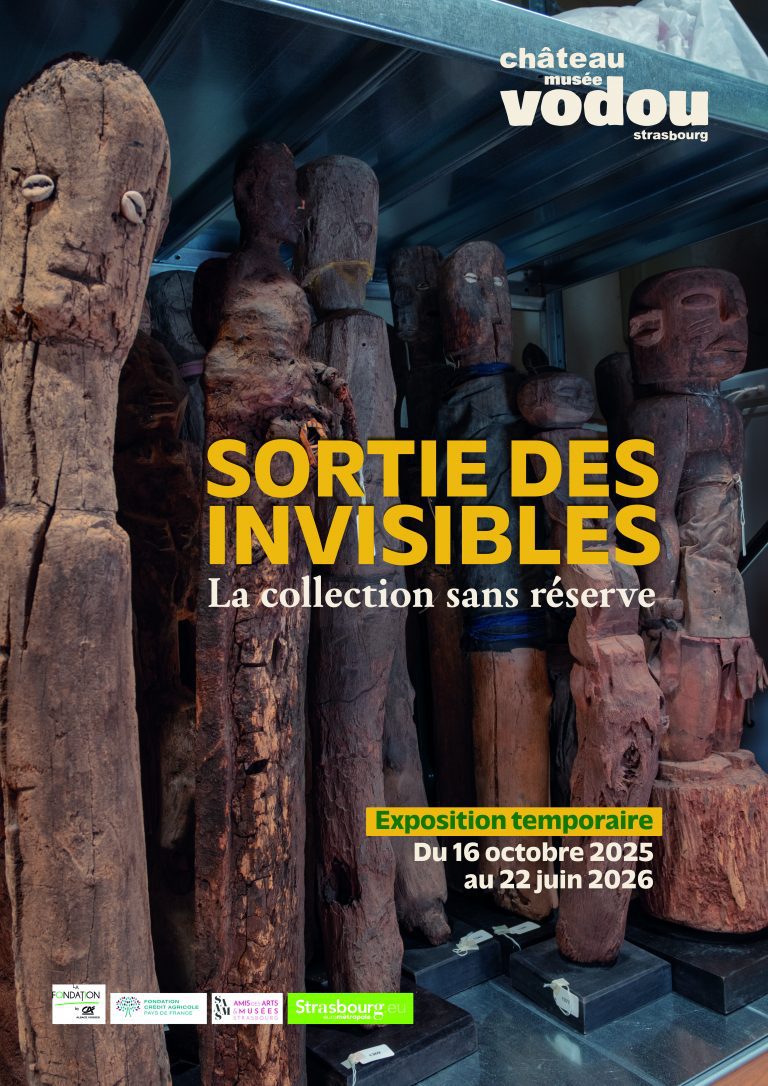
The Wodu Museum in Strasbourg offers visitors an unexpected experience
- There are insights into an imaginary world;
- It presents an alien, vibrant culture with its collection of unusual objects.
The term «Wodu» is spelled «Vodoun» in Benin, «Vaudou» in Haiti, and «Voodoo» in Louisiana, where it still has some followers today. Various terms for different practices that have evolved according to local circumstances. Experts estimate that there are currently 200 million followers of different variations of Wodu worldwide.